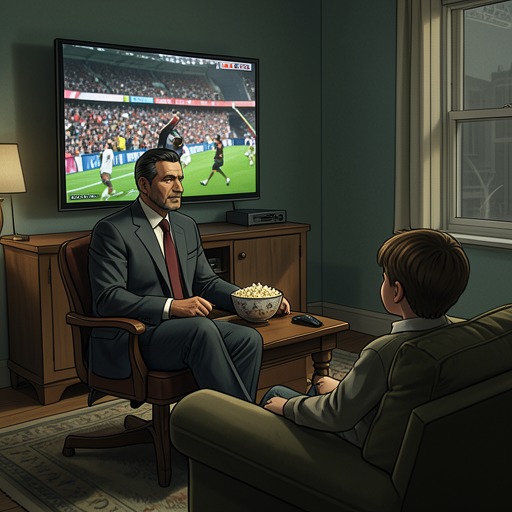
Edison Appaloosa–Travis Appaloosa father-son relationship
Big BrotherThe father-son relationship between Edison Appaloosa and Travis Appaloosa is defined by a persistent mismatch between television’s polished family myth and the difficult intimacy of their real lives. Travis’s role as Emory Fields on Joint Custody gives Edison a public image of fatherhood against which to measure his own father; their shared connection to the show can summon childhood closeness, but it does not resolve their estrangement. In adulthood, the relationship is conducted through missed understanding, indirect contact, and Pandora’s attempts to keep its consequences from consuming the rest of the family.
The television father and the real one
Travis appeared on Joint Custody as Emory Fields, a more successful paterfamilias than the self-absorbed father Pandora and Edison knew at home. The contrast was not simply between a fictional character and an actual parent: the children on the program seemed, to Travis himself, more real than his own children. The show’s carefully arranged family life therefore became an unsettling parallel to the Appaloosas’ household, offering an idealized version of the father Edison did not have.
The difference was visible even in the way Travis’s identity was made. He was Hugh Halfdanarson in private and Travis Appaloosa on television; casting had favored the wholesome, farm-stock quality of the former, although Travis took pride in his sophistication. The program’s Iowa setting did not make him look like a displaced Angeleno: to its producers, he fit right in. The gap between the persona and the man gave the show a double significance for his children, who could mock its sentimentality while recognizing its power to frame their family history.
Edison’s piano and the rivalry over origins
Edison’s jazz-piano ambitions became a point of friction because Travis believed his son was competing with a television character. Edison was sensitive to any suggestion that he had taken up piano because of Caleb Fields, the fictional son played by Sinclair Vanpelt. In reality, Edison studied with Jack Washington, a respected older Black musician in South Central; the family’s driver kept Washington’s address from the parents, and Pandora helped keep it secret. Travis nevertheless treated Edison’s ambitions as imitation of a contrivance, even as the show’s fictional children seemed to hold greater reality for him than his actual ones.
The tension had an early, humiliating scene. During a studio rehearsal period, Edison demonstrated proper crossed-hand piano technique to Sinclair, whose character Caleb was known as a young jazz enthusiast. Sinclair laughed and called the coincidence too droll. His condescension secured Edison’s lasting enmity, but the episode also exposed the odd triangle at the center of the father-son conflict: Edison’s genuine musical skill was being judged through a television role, while Travis’s real son stood at the margins of the set where Travis played a fictional father.
A family language made of television
For Pandora and Edison, Joint Custody remained a shared point of access to a childhood they could otherwise ridicule or avoid. Pandora had grown up among distorted doubles: Travis as Emory, herself as the fictional Maple Fields, and the family’s private disappointments alongside the program’s idealized attempts at reconciliation. She could dismiss the show as crude and hammy, yet still value its depiction of siblings who form an intense alliance while their parents play fools. In her reading, the children’s deepest loyalty is to each other, not to either parent.
That sibling bond shaped how the marriage around Edison’s arrival was strained. Fletcher resented the force of Pandora’s attachment to her brother, while Pandora initially believed her devotion as a sister did not diminish her devotion as a wife. When she and Edison stayed up late together, singing the Joint Custody theme, Fletcher’s interruption brought back the childhood pattern of a father entering the kitchen and ending the children’s private world. The remembered geometry made Pandora feel that her real breach was not merely keeping Fletcher awake, but recreating a scene in which her husband had become the outsider and Edison the primary companion.
The theme song could still draw the siblings together decades later. At two in the morning, Edison began singing its opening words in his deep, robust voice, and Pandora joined in to see whether she remembered the lyrics. The song was less a declaration of affection than a stored family language: its words had been engraved by repetition, available even when direct emotional disclosure was not. Edison could talk expansively about jazz and other subjects without revealing much of himself; the shared television refrain offered intimacy by way of memory rather than confession.
Distance, mediation, and the later calls
As Edison’s weight became impossible to ignore, Pandora’s care for him also exposed the limits of Travis’s attention. She observed that Edison responded to the kindness of Cody, who asked him for piano lessons, while strangers often looked at him with hostility, especially in supermarkets. Fletcher argued that Edison was using Cody’s goodwill and that her compassion might amount to pity rather than help. The exchange locates the father-son relationship within a wider family system: concern for Edison passed through Pandora, while the people closest to him disagreed about whether their kindness supported him or enabled his dependence.
Pandora also acted as an information barrier between Edison and Solstice, who accused her of preventing a real sisterly connection. Pandora insisted that Edison’s weight problems deserved privacy, and told Solstice that reaching out was her own choice rather than Pandora’s responsibility. The secrecy reflected Pandora’s long habit of protecting family members from one another’s indifference, but it also meant that she remained the person who managed what others knew about Edison’s condition. Travis, meanwhile, was not shown as the dependable center of a family rescue; his place in Edison’s life was filtered through the same uneven attention that had marked their earlier years.
When Travis later called, Pandora reported that Edison had gone five months without Fritos, was exercising daily, had recovered his spirits, and was practicing piano intensely. Travis answered not with sustained interest in his son’s progress but with a complaint about a television premise: he dismissed the story of Walter White, a timid high-school chemistry teacher who becomes a drug dealer, as implausible and predicted it would not last a second season. His response turns the call into a small reprise of the relationship’s central imbalance. The news concerns Edison’s body and music; Travis’s attention veers toward his own judgment of television.
The call nevertheless brought a practical opening. Travis said he had found one of Pandora’s belongings, then complained about costs and the weak bids for Joint Custody memorabilia he was trying to auction online, including Caleb Fields’s sheet music. Pandora offered to send money in exchange for putting Tanner on the phone. She then redirected her father’s entertainment-industry knowledge toward her stepson: Travis could guide Tanner, help him learn the business, and give him research work organizing papers and interviewing people about Joint Custody for Travis’s proposed memoir. This exchange shows Pandora trying to make useful contact across generations where direct father-son intimacy had failed to take hold.
Estrangement and the family pattern
The relationship’s most consequential effects are not confined to private conversations between father and son. Pandora describes Edison’s appetite and self-destructive scale as part of a broader pattern of making life dramatic: in her interpretation, he did not merely risk failure but pursued it on a grand scale. Her account connects his struggles to the family’s history without reducing them to Travis alone. The program’s exaggerated fatherhood, the siblings’ strong alliance, and the real father’s intermittent presence together form the emotional setting in which Edison’s adult life unfolds.
The same family pattern later appears in Pandora and Fletcher’s marriage. When Fletcher learned that Pandora had left for an extended period, he accused her of demonstrating who mattered most to her and said she no longer understood their shared business. He declared that he wanted a divorce in front of Pandora and Edison, although he had not used that word even when demanding Edison leave the house by the date of his flight reservation. Travis’s earlier intrusion into the children’s private world thus echoes into the next generation: a sibling bond that had helped Pandora and Edison survive childhood now becomes a source of conflict in her marriage.
Travis and Edison are neither reconciled through the television legacy nor wholly disconnected from one another. The program supplies songs, images, and memorabilia through which the family can remember itself, but those objects do not guarantee attention or understanding. Their relationship remains mediated by Pandora, by Edison’s music, and by the fiction of a father who knew how to keep a television family together. The contrast is the relationship’s defining irony: the show gives the Appaloosas a common story, while its ideal of family continually makes the real one more visible.